
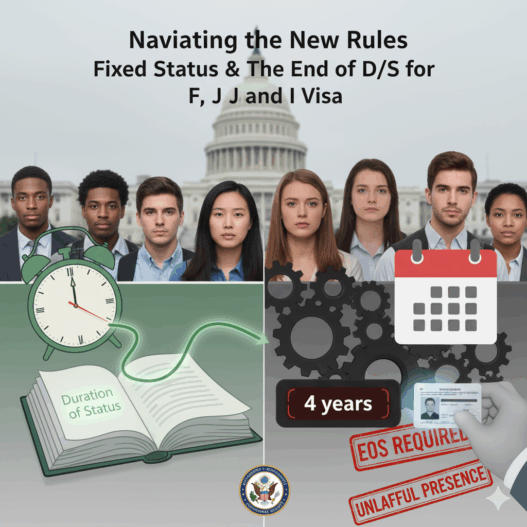
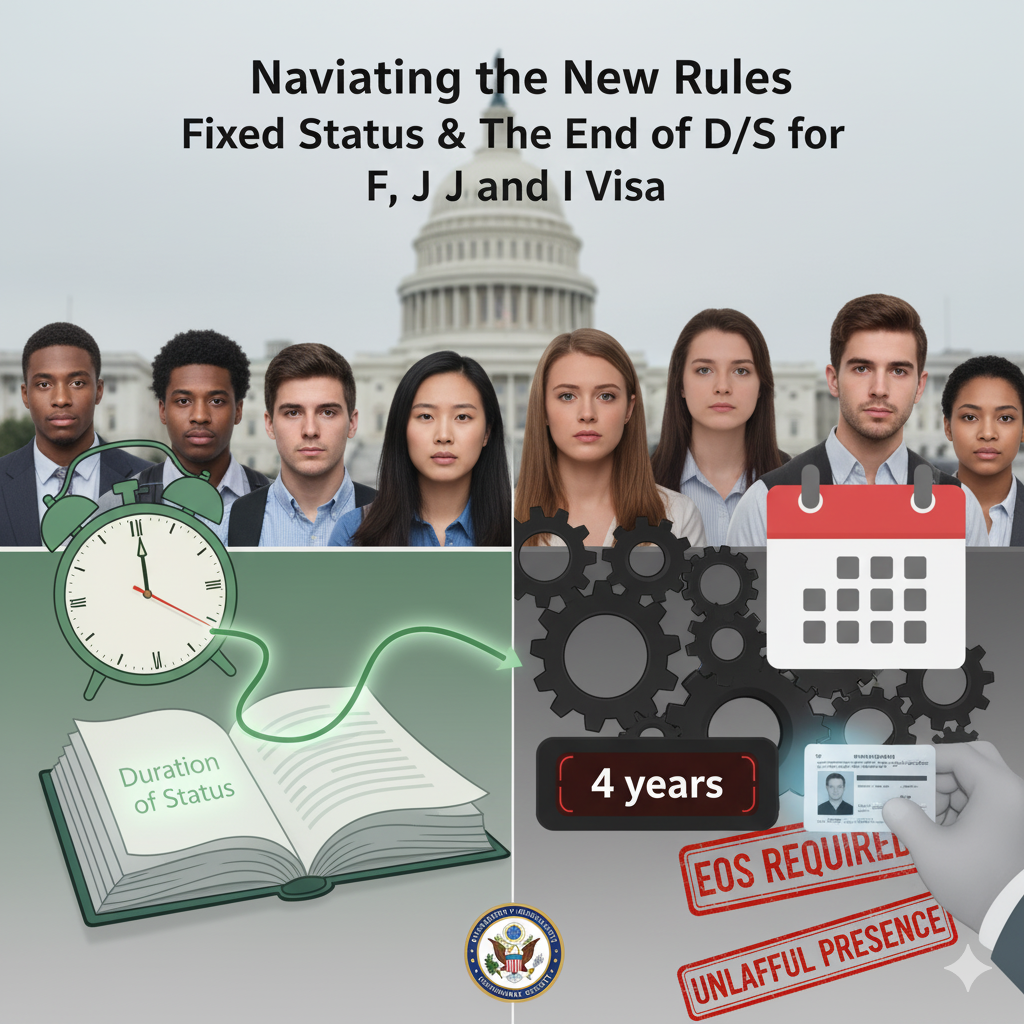
Traditionally, F-1 students (academic), J-1 exchange visitors, and I-1 foreign media representatives—and their dependents—have been admitted under a Duration of Status (D/S) framework. This means these individuals remain in the United States as long as they maintain their eligible status—through their study, exchange program, or assignment—without recurring involvement from immigration authorities.
DHS is now proposing to replace this open-ended system with fixed admission periods, aligning it with the framework applied to most other nonimmigrant categories
What’s Changing: Fixed Admission Periods and Stricter Oversight
1. Defined Timeframes
- F-1 students: Admitted up to their program end date—including post-completion Optional Practical Training (OPT)—but capped at 4 years, plus a new 30-day grace period (reduced from 60 days)
- Exceptions: F-1s in English language programs would be capped at 24 months + 30 days; those in public high schools limited to 12 months + 30 days
- J-1 exchange visitors: Admitted for up to 4 years, plus a 30-day grace period
- I-1 media representatives: Admitted based on assignment length, generally up to 240 days. However, for passport holders from mainland China, the cap is 90 days
2. Extensions of Stay (EOS) Now Required
Under the new system, individuals needing more time must submit a formal Extension of Stay (EOS) request to USCIS, including biometric data and applicable fees—regardless of whether their program has already been extended by their institution or sponsor
3. Accrual of Unlawful Presence Begins at Fixed Expiry Date
Unlike the current system—where unlawful presence only accrues if an F, J, or I nonimmigrant explicitly loses their status or is found in violation—the new rule would begin accruing unlawful presence as soon as the fixed admission expires without an approved extension. This aligns these groups under the same stricter framework as other visa holders
4. More Frequent Oversight: Biometric Collection
Particularly for J-1 exchange visitors, the shift to fixed admission periods gives DHS more frequent opportunities to conduct vetting and biometric collection, enabling better oversight and a stronger defense against status abuses or fraud
5. Transition Provisions for Those Currently on D/S
DHS includes thoughtful transition policies to allow individuals currently admitted under D/S to smoothly adjust to the new system:
- They may remain in status until their program end date or up to the 4-year cap—whichever is earlier—plus the grace period.
- If they need additional time, they must apply for an EOS or depart and re-enter — the same as new arrivals
6. Public Commentary and Regulatory History
This is not DHS’s first attempt at this policy shift. A similar NPRM was released in September 2020, but was ultimately withdrawn in 2021. The current proposal represents a revived effort with enhanced requirements. Similarly in 2020, DHS received more than 32,000 public comments—overwhelmingly opposed—citing concerns about burdens on students, trainees, and employers
7. Additional Restrictions for F-1 Students
Beyond fixed admission periods, the proposal introduces new compliance requirements for F-1 students related to program transfers, changes in educational objectives, and movement across academic levels:
- Transfer limitations: Students who wish to change schools must complete at least one academic year at the institution that initially issued their Form I-20 (or its successor form), unless an exception is expressly authorized by SEVP.
- Graduate program restrictions: F-1 students at the graduate education level would be prohibited from changing programs midstream once their course of study has begun.
- Educational objective changes: The rule outlines formal procedures and requirements that F-1 students must follow when seeking to change their educational objectives while maintaining status.
- Advancing education level only: Students would be permitted to move only to a higher educational level (e.g., bachelor’s → master’s, or master’s → doctoral). They would be barred from starting another program at the same or a lower level while in F-1 status.
Impacts and Strategic Implications
For Students and Exchange Participants:
- Must remain vigilant about dates and compliance—admission now ends on a fixed schedule.
- Risk of accruing unlawful presence is higher if an extension isn’t timely filed.
- Reduced grace periods give less time for post-program preparation.
For Institutions and Sponsors:
- Increased administrative burden to track and assist on EOS filings.
- Shift from institutional signature (DSO/s) to reliance on USCIS adjudication.
For DHS and Enforcement:
- Greater control and oversight; opportunity to catch noncompliance earlier.
- More uniform application of immigration rules across nonimmigrant categories.
What’s Next? And How You Can Take Action
- Public comment period: Open for 60 days from August 28, 2025 (until about October 27, 2025). Your voice matters—especially if you’re a student, sponsor, institution, or employer affected by this change
- DHS will review feedback and may revise the proposal before finalizing.
- If passed, expect implementation guidance from DHS, USCIS, SEVP, and SEVP-certified schools.
Final Thoughts
This proposed rule reflects DHS’s intent to move away from flexible, institution-led D/S policy and implement fixed admission periods for F, J, and I nonimmigrants. The key benefits—enhanced oversight, more predictable departure schedules—come at a cost: increased complexity, reduced flexibility, and heightened risk of legal jeopardy for individuals unaware of the change.
The ripple effects will be felt across academia, exchange programs, media assignments, and the broader visa-driven workforce. Stakeholders should stay informed, contribute feedback, and prepare institutional systems for tighter timelines and monitoring.